






How Much LNG Storage Does a 25 MW Data Center Need?
As artificial intelligence, cloud computing, and hyperscale data centers continue to grow, one challenge is becoming increasingly common: power availability.
Across the United States, developers are discovering that utility grid interconnections can take years to complete. In some regions, available capacity simply does not exist to support new large-scale developments. As a result, many project developers are evaluating natural gas and LNG-based power generation as part of their energy strategy.
One of the first questions asked during project planning is: how much LNG storage does a 25 MW data center actually need?
The answer starts with fuel consumption. At a typical heat rate of 10 MMBtu per megawatt-hour for single-cycle gas generators, a 25 MW facility burns approximately 3,000 gallons of LNG per hour at full load. That number drives every storage decision on the project.
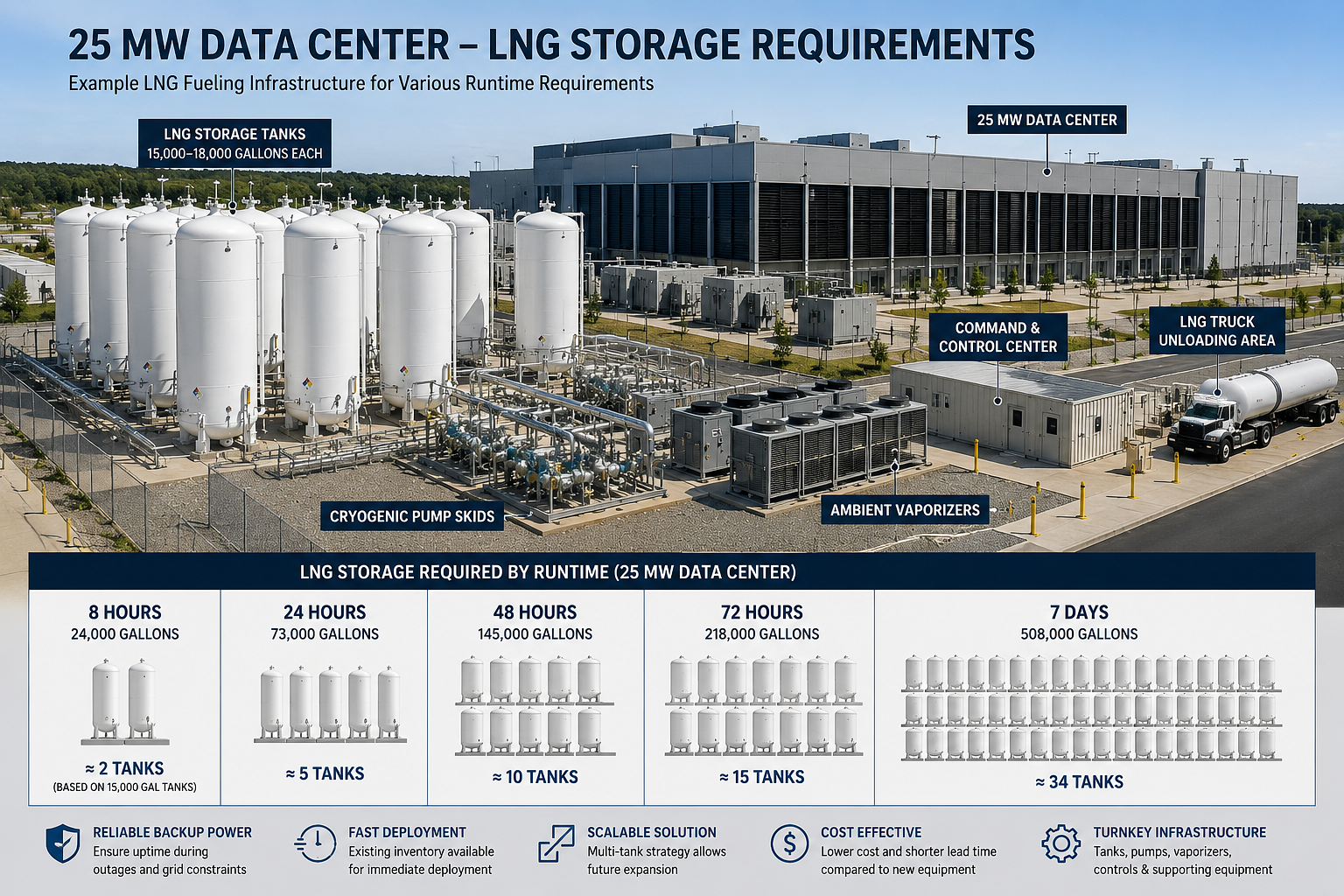
Here is what that looks like across common runtime requirements:
8 hours of runtime requires approximately 24,000 gallons 24 hours of runtime requires approximately 73,000 gallons 48 hours of runtime requires approximately 145,000 gallons 72 hours of runtime requires approximately 218,000 gallons 7 days of runtime requires approximately 508,000 gallons
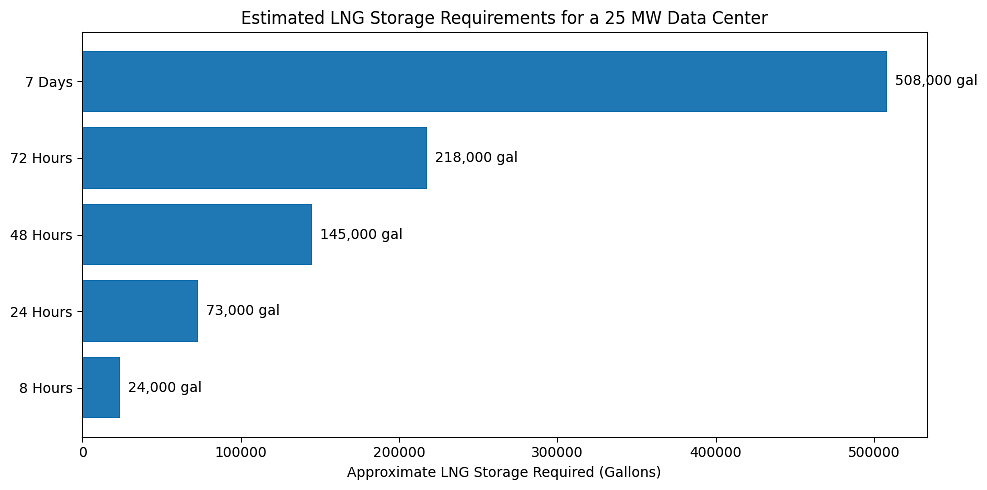
Most storage engineers also recommend building in a 15 percent reserve margin on top of these figures so the facility never draws tanks completely to zero.
The good news for developers with aggressive timelines is that existing LNG storage equipment can be deployed significantly faster than new-build infrastructure, which typically carries a 9 to 18 month lead time from order to operation.
Why LNG Storage Matters
LNG storage is not simply about storing fuel. It is about ensuring operational continuity.
Whether LNG is being used for emergency backup generation, peak shaving, microgrid support, or primary power generation, storage capacity ultimately determines how long a facility can operate before additional fuel deliveries are required.
For data centers, uptime is everything. A facility that loses power loses revenue, damages reputation, and in some cases violates service agreements with customers. Fuel storage is not a secondary consideration. It is a core part of the overall reliability strategy, no different than redundant cooling systems or backup network connections.
How Runtime Requirements Drive Storage Size
The amount of LNG storage required for a 25 MW facility depends primarily on how long the facility needs to operate independently of the utility grid or without a scheduled fuel delivery.
Common runtime targets include:
8 hours, which covers a standard utility outage window and is the minimum threshold many facilities plan around
24 hours, which provides a full day of operational independence and time to arrange emergency fuel deliveries if needed
48 hours, which is a common target for facilities in regions with less reliable grid infrastructure
72 hours, which is increasingly the minimum standard for mission-critical data center operations
7 days or longer, which applies to facilities designed to operate as primary generation sites or remote locations with limited delivery access
Additional factors that affect storage sizing include generator efficiency and heat rate, the actual operating load of the facility at any given time, a reserve margin to ensure tanks are never drawn to zero, and future expansion plans that may increase power demand.
Why Many Developers Use Multiple LNG Tanks
One common approach in large power generation applications is the use of multiple LNG storage tanks rather than a single large vessel. A multi-tank strategy provides several practical advantages.
Operational redundancy means individual tanks can be isolated for inspection or maintenance without taking the entire fuel supply offline. Easier maintenance scheduling allows tank work to happen without planned outages to the overall system. Increased storage flexibility allows capacity to be added incrementally as the project grows. Expansion capability means additional tanks can be manifolded into an existing system without major engineering changes. Reduced project risk means a problem with one tank does not compromise the entire fuel supply.
For large-scale power applications, multiple tanks can be manifolded together to create substantial onsite fuel reserves while maintaining the operational flexibility the facility needs.
The Equipment Lead Time Problem
One of the most significant challenges facing data center developers today is equipment availability and lead time.
New LNG infrastructure is not ordered off a shelf. Engineering, fabrication, permitting, and delivery for new-build LNG equipment typically requires 9 to 18 months from order placement to operational status. For a developer trying to bring a facility online in 6 to 12 months, that timeline creates a serious problem.
Existing LNG infrastructure that is already built, tested, and available for deployment offers a faster path. Equipment that originated from previously operating LNG facilities can often be inspected, transported, and commissioned in a fraction of the time required for new equipment.
This is one of the primary reasons developers with time-sensitive projects are actively looking for available used LNG equipment rather than waiting on new-build lead times.
Available LNG Storage Inventory
Project Arctic Uno represents one of the largest inventories of immediately available LNG equipment currently in the United States. The inventory originated from the decommissioning of previously operating LNG and LCNG fueling facilities across the country.
Available LNG storage equipment currently includes approximately 18 tanks in the 15,000-gallon range, approximately 8 tanks in the 18,000-gallon range, and approximately 4 tanks in the 6,000-gallon range. Total available storage capacity is approximately 450,000 gallons, which is enough to support nearly 6 days of continuous 25 MW generation.
These assets can be deployed individually or combined into larger fuel storage systems depending on project requirements. The inventory also includes cryogenic pumps, vaporizers, command centers, and supporting balance-of-plant infrastructure.
LNG Storage Is Only One Part of the Solution
A storage tank alone does not create a functioning LNG fuel system.
Most data center and power generation projects also require cryogenic transfer pumps to move LNG from storage to the vaporization system, vaporizers to convert LNG back into pipeline-quality natural gas for generator fuel, pressure control and regulation systems to manage gas delivery pressure, control and automation systems to monitor and operate the facility safely, safety and emergency shutdown systems required by code and insurance, and fuel transfer infrastructure to connect the LNG system to the generator sets.
The storage tank is the starting point. A complete LNG facility requires all of these systems working together to safely and reliably deliver natural gas to generators and power equipment. Developers who focus only on tank capacity during early planning often encounter delays and cost overruns when the balance-of-plant requirements become clear later in the project.
The Future of Data Center Power
Data center energy demand is not slowing down. Artificial intelligence applications, cloud infrastructure growth, and the increasing digitization of nearly every industry are driving power requirements that existing utility infrastructure was not built to handle at this scale or pace.
LNG is becoming a serious part of the conversation for utility backup power at facilities where grid reliability is a concern, peak shaving applications where on-site generation reduces demand charges during high-cost periods, temporary generation during the period between a facility coming online and its permanent utility interconnection being completed, microgrid development where a facility wants energy independence rather than full grid dependence, remote power applications where pipeline access is not available or practical, and AI infrastructure projects where power availability is the limiting factor on development timelines.
The most effective LNG storage strategy depends on project-specific power requirements, runtime expectations, fuel delivery logistics, and long-term expansion plans. Every project is different, and storage sizing should always be based on a detailed analysis of the actual facility requirements rather than generic rules of thumb.
Frequently Asked Questions
How much LNG does a 25 MW data center consume per hour?
At a typical heat rate of 10 MMBtu per megawatt-hour, a 25 MW facility burns approximately 3,000 gallons of LNG per hour at full load. Actual consumption will vary based on generator type, efficiency rating, and operating load factor. Data centers rarely run at full nameplate capacity continuously, so real-world consumption is often somewhat lower than the theoretical maximum. Every project should be evaluated using the actual specifications of the generator equipment being deployed.
How much LNG storage is needed for 72-hour backup at 25 MW?
Approximately 218,000 to 250,000 gallons, depending on generator efficiency and whether a standard 15 percent reserve margin is included. That is roughly 15 tanks in the 15,000-gallon range, manifolded together into a single fuel system. Current inventory includes approximately 450,000 gallons of available storage capacity, which is enough to support nearly 6 days of continuous 25 MW generation with equipment that is available for immediate deployment.
Can multiple LNG tanks be connected together?
Yes. Multiple LNG storage tanks are routinely manifolded together to increase total fuel capacity and improve operational flexibility. This is the standard approach for large power generation applications. A multi-tank system also provides redundancy, since individual tanks can be isolated for maintenance without taking the entire fuel supply offline.
What is the difference between LNG and CNG for data center backup power?
Both are viable options but they serve different applications. CNG works best within roughly 60 miles of a pipeline connection and suits shorter runtime requirements. LNG has significantly higher energy density, can be transported economically by truck up to 300 miles, and scales more effectively for extended runtime needs. For data centers requiring multi-day backup capability or located in areas without direct pipeline access, LNG is generally the preferred solution.
Can LNG replace diesel backup generators?
LNG-fueled generation is a direct substitute for diesel in most backup and primary power applications. Natural gas generators produce lower emissions than diesel, avoid the fuel degradation and tank maintenance issues common with long-term diesel storage, and face fewer environmental permitting constraints in many jurisdictions. The infrastructure requirements differ since LNG requires cryogenic storage and vaporization equipment rather than a standard above-ground diesel tank, but generator performance is comparable and operating costs are often lower.
How many LNG deliveries would a 25 MW facility require?
A standard LNG tanker truck carries approximately 9,000 to 10,000 gallons. A 25 MW facility running continuously consumes roughly 73,000 gallons per day, which would require approximately 7 to 8 truck deliveries per day for a primary power application. For backup power with scheduled top-off deliveries, frequency depends on onsite storage capacity and the minimum reserve level the facility wants to maintain. Most backup strategies target a minimum 72-hour reserve at all times, with deliveries scheduled to keep storage well above that threshold.
How much LNG storage is available for immediate deployment?
Current inventory includes approximately 450,000 gallons of LNG storage capacity across multiple tank sizes, including roughly 18 tanks in the 15,000-gallon range, 8 tanks in the 18,000-gallon range, and 4 tanks in the 6,000-gallon range. This equipment originated from decommissioned LNG and LCNG fueling facilities and is available for immediate deployment, bypassing the 9 to 18 month lead times associated with ordering new equipment.
What other equipment is required besides LNG storage tanks?
Most LNG projects also require cryogenic transfer pumps, vaporizers to convert LNG back to pipeline-quality natural gas, pressure control and regulation systems, control and automation equipment, safety and emergency shutdown systems, and the balance-of-plant infrastructure needed to connect fuel delivery to generator sets. The storage tank is the starting point, but a complete LNG fuel system requires all of these components working together.
Why are data centers evaluating LNG over standard utility grid power?
Grid interconnection queues in many U.S. markets now run three to five years, and available capacity in high-demand regions is constrained or simply unavailable. LNG-based generation allows developers to bring facilities online on their own timeline, independent of utility interconnection schedules. It also supports microgrid configurations, peak shaving strategies, and hybrid approaches that combine on-site generation with grid power to reduce long-term operating costs while maintaining the uptime reliability that data center customers require.
Need Help Evaluating LNG Storage Requirements?
Gas Equipment For Sale can assist with LNG storage tanks, cryogenic pumps, vaporizers, controls, and complete LNG infrastructure solutions for data center, utility, industrial, and power generation applications. Current inventory includes approximately 450,000 gallons of immediately available LNG storage capacity with no new-build lead times.